
Poland 2025
Poland is a country I've only briefly visited, with a fleeting visit to Auschwitz-Birkenau back in the late 2010s, and I've always wanted to return to check out the wildlife, so I got on a plane and went.
It wasn't quite that easy, the trip was booked a whole year in advance due to the popularity, which gave me time to find a suitcase big enough to contain all the cold weather gear I was told I'd probably need. After many hours of shopping, many pounds spent and packing, repacking and re-repacking the suitcase, I thought I was being a bit over the top with the amount of clothing needed for a mid February visit to the Bialowieza region...I was very wrong!
Checking the forecasts in advance, the temperatures were showing a slightly chilly -1 to -3 degrees - no biggie though, the office is not much warmer during the winter, so probably not really that cold. Again, and I cannot stress this enough, I was wrong!
The alarm was set for a time hitherto unknown to man, and I made my way to the airport, spurred on by the thought of a decent breakfast in departures. Skip forward a few hours, and flying over the Polish countryside, I see a thin blanket of snow on the ground. We land during a snow shower and after a short wait at the arrivals hall, I meet up with our photographer for the week, Sean Weekly, and the other guests and head outside to wait for our minibus. At this point, it was sunny, snowing and very cold!
Skip ahead 4 hours and we arrive at the guest house for the week and prepare for the next few days. Over dinner, we're told it can reach -15 degrees Celcius and layering up is key, especially in the bird hides. We're also told the hides have gas heaters, so can get quite toasty.

Day 1 and we head out at 5am in the 4x4 to the bird hide, where we spent the day. It was about -17 degrees and I'm wondering whether I brought enough layers! At the bird hide, it's not much warmer, and everything is frozen over. The heater was on, the fans set to work clearing the ice from the large windows inside (the hides had floor to ceiling one way glass so the wildlife couldn't see in). The temperature was so low, the hide never actually got warm and the windows took about 3 hours to fully defrost, but as soon the fans switched off, our breath immediately started to re-freeze on the windows.
Enough of me moaning about the cold, onto the wildlife. It started off fairly slow but soon picked up. Jays were everywhere, feeding on the meat left out for the raptors. A number of huge Ravens also made an appearance and it wasn't long before our first raptor appeared, a Common Buzzard. There were several Buzzards which came and went throughout the day, occasionally fighting each other for food and often being harassed by the Ravens.
Around lunchtime, we had a visit from a pair of White Tailed Sea Eagles, male and female, which came down to feed. Later we would get a very apprehensive, and slightly suspicious, adolescent Sea Eagle, which was somewhat intimidated by the Ravens and Buzzards. We left the hide after sunset, satisfied with the days sightings!

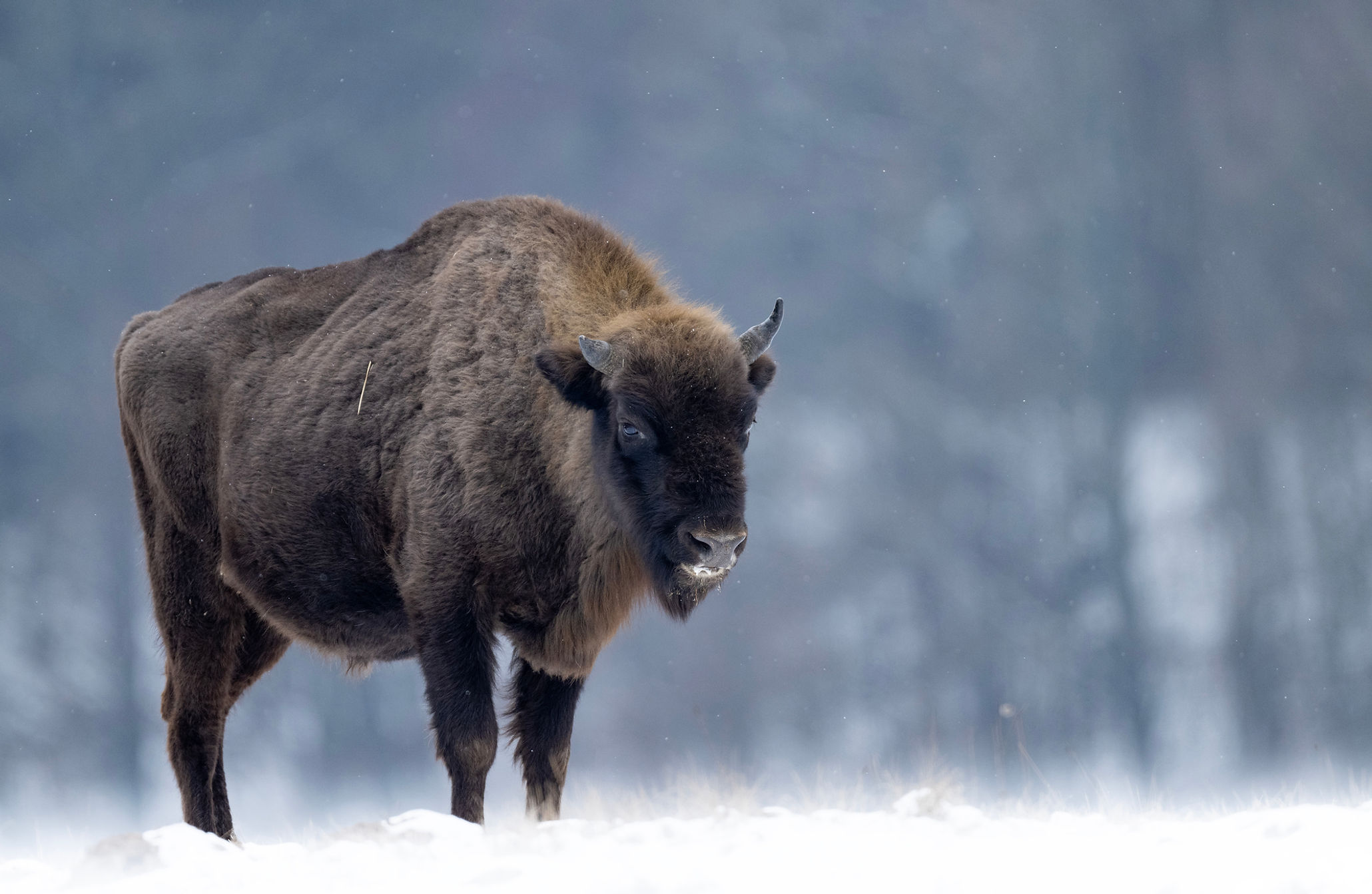
Day 2 and as we were going to spend the day searching for Bison, we could have a lay in, so the alarm was set for 5am with a 6am departure. We stuffed our gear in the cars and hit the road. Our guide took us to a number of feeding stations and we managed to find some Bison just before 8am that morning. It was a large herd of females, which naturally headed pretty swiftly to the forest shortly after we arrived. We quickly found another herd though and managed to get relatively close, isolating a few through the lens and laying in the snow to get some interesting angles. We then headed North to the Siemianowka Reservoir, which had completely frozen over and was covered in a layer of snow. We had some excellent sightings of White Tailed Eagles just as the snow started, with a lone adolescent flying over the lake with a chunk of food in its huge talons. We then collectively decided to head for a café to warm up and recharge.
After lunch, the snow continued, so it was back to a herd we saw earlier to catch the Bison in the snow. Again, laying down to lower the horizon level and add a soft white haze to the bottom of the image to help soften the horizon, we got some cracking shots of Bison as the snow came down.
We continued to drive around, our guide using what can only be described as superhuman senses to pick out Bison in the forest. Unfortunately they bolted pretty quickly as we approached, despite how careful we were.
Our final stop for the day was an area of woodland, somewhere in the Bialowieza area. The feeding station was empty, but there was evidence of Wolves with fairly fresh tracks leading deeper into the forest. Our guide took us back towards the vehicles through another area of the forest - this was the kind of forest you see in horror films, in which every direction looks exactly the same and is very easy to become lost and disorientated! We quickly spotted a lone male Bison, feeding on acorns on the forest floor. He was enormous and fully aware of our presence but not in the slightest bit fussed. This brought to an end the second full day in Poland.
Day 3, and a visit to the home of one of our guides, but not for tea and biscuits! In his garden was a wonderful reflection pool (frozen and covered in snow, so not really reflecting much) set in a very natural environment and we were told was a real haven for bird life. We didn't have to wait long for our first guest, a Northern Goshawk. Its piercing orange eyes cut through the cold air, and it perched briefly on a branch before flying off into the distance.
Throughout the day, there were plenty of smaller visitors; Great Tits queued politely on a branch for food hidden inside, Greater Spotted Woodpeckers visited non-stop, taking hazelnuts and generally being quite abusive towards some of the other smaller birds and Jays also made an appearance. The exciting visitors were a lone Goldcrest, quite a number of Crested Tits and a Hawfinch which, along with the Woodpecker, looked stunning during the heavy snow shower early in the afternoon.
Our favourite visitor though was a Red Squirrel which had the most amazing ear tufts. It returned often, taking whole hazelnuts to hide somewhere before returning for more. I did attempt a jumping squirrel shot, but failed spectacularly each time!
The light held well into the late afternoon, but by 4pm, the activity had died down, so we packed up and reflected on another successful day. I probably should note that the facilities weren't quite what we were expecting. Toilets for example consisted of bottles and buckets with toilet lids and no heating. Comfort breaks certainly weren't comfortable! Wearing many layers of clothing also didn't help, especially in the last hide (which was about 5ft high from floor to ceiling). Whilst these adventures might sound exciting, they certainly don't always come with luxuries, but that just adds to the authenticity

Day 4 began with an early start, 5am to be exact, and the weather was cold...very cold! The temperatures hit a frigid -22C, which was cold enough for the moisture in my breath to freeze to my pathetic excuse for a beard within a matter of minutes! A short drive from the guesthouse and we found Bison just as the sun was rising! There were only two and they were covered in frost, their coats glistening white. After nearly half an hour out in the -20C (it had warmed slightly by then), I was as frosty as the Bison, in fact I probably could have passed for Santa!
Throughout the day, we covered many more miles in our search for Bison, coming across the occasional group. Other highlights were foxes, Red and Fallow Deer and even an Elk (much to the annoyance of the other group!)
Cut to the end of the day and the weather had warmed to about -3 degrees C, and we found ourselves in a field, waiting for the sun to set. Behind a nearby copse of trees was a herd of Bison, in an open field with nothing between them and the setting sun - it all seemed to be coming together rather too well! A hour after arriving, we headed out on foot and soon came across the herd. The light was incredible, creating stunning silhouettes and the air was still cold enough for the Bison's breath to be clearly visible. It was a perfect end to another long day!

Day 5 and back in the hides, although this one was not designed for those over 5ft, which put my 6ft -2 inch (sounds better than 5ft 10!) stature at a bit of a disadvantage! Undeterred, I powered on through the day and boy what a day it was!
It started in the traditional way, very bloody cold and we doing all we could to keep warm. The first visitors to the hide were Goshawk, briefly feeding before disappearing. Buzzards also came and went throughout the day and at the snowy reflection pool next door, Great Tits were still queuing for food. Jays were around at times just as they were earlier in the week, as were the Greater Spotted Woodpeckers, but this time joined by Middle Spotted and Grey Headed Woodpeckers.
Just before lunchtime, the Eagles arrived. An adolescent Eagle perched in a nearby tree before flying down to feast on the meat left out for it and was soon pushed off by an adult White Tailed Eagle. What happened next was completely unexpected - the adolescent tried to take on the adult and a fight ensued. Feathers and snow were flying everywhere and after a short tussle, the adult won and asserted its dominance over the other Eagle.
The rest of the day wasn't nearly as exciting; the Buzzards continued come and go, the Goshawk returned later in the afternoon as did one of the Eagles. An inquisitive Fox was also around, briefly appearing by the distant trees before disappearing back into the undergrowth. Before we knew it, the light had gone and the cars arrived to whisk us back to the guesthouse for the final night, before flying home the following day.

The cold weather presented some really tricky shooting conditions. I was expecting the air to be crisp and clear, but in actual fact, there was a lot of haze which drastically reduced sharpness to the point images were unusable. Haze in winter is typically caused by temperature inversions. Cold air sinks due to the density and warm air rises. During temperature inversions, warm air settles above cold air, which traps any pollutants near to the ground. This can appear similar to a heat haze and there's very little which can be done besides using shorter focal lengths to reduce the effect. Longer focal lengths narrow the field of view, bringing objects further away much closer. The further away the subjects are, the more air you have to shoot through, and during inversions, the effects can be greatly magnified.
The other challenge was the sheer coldness, at one point -22 degrees C. Cameras generally don't like the cold, and neither do humans. My shutter button started to freeze up and become stiff, and frost started to appear inside the lens almost as soon as I exited the vehicle. I had to be incredibly careful to not expose the lens to the warm air in the car too quickly, instead using the lens cover to protect the elements and prevent condensation forming. Luckily the frost quickly went and the frost didn't cause any issues with image quality.
Another cold related challenge was my own extremities freezing. I got around this by using a pair of convertible mittens - gloves which had a cover that could be pulled over when I wasn't shooting. The cover also doubled up as a holder for some hand warmers, so my fingers stayed nice and toasty! Cold induced camera shake was also a slight issue when stood up, but we solved this by laying in the snow. Getting the camera as low as possible was key, and a lot of the time, I kept my camera on the ground, using the live view screen to frame, compose and shoot, allowing me to keep a better eye on the wildlife, plus I didn't really want to put my face down in the snow!


